Dental Implants
A permanent replacement for missing teeth: a titanium post that fuses with your jawbone like a natural root, topped with a custom crown that looks, feels, and functions like your own tooth.
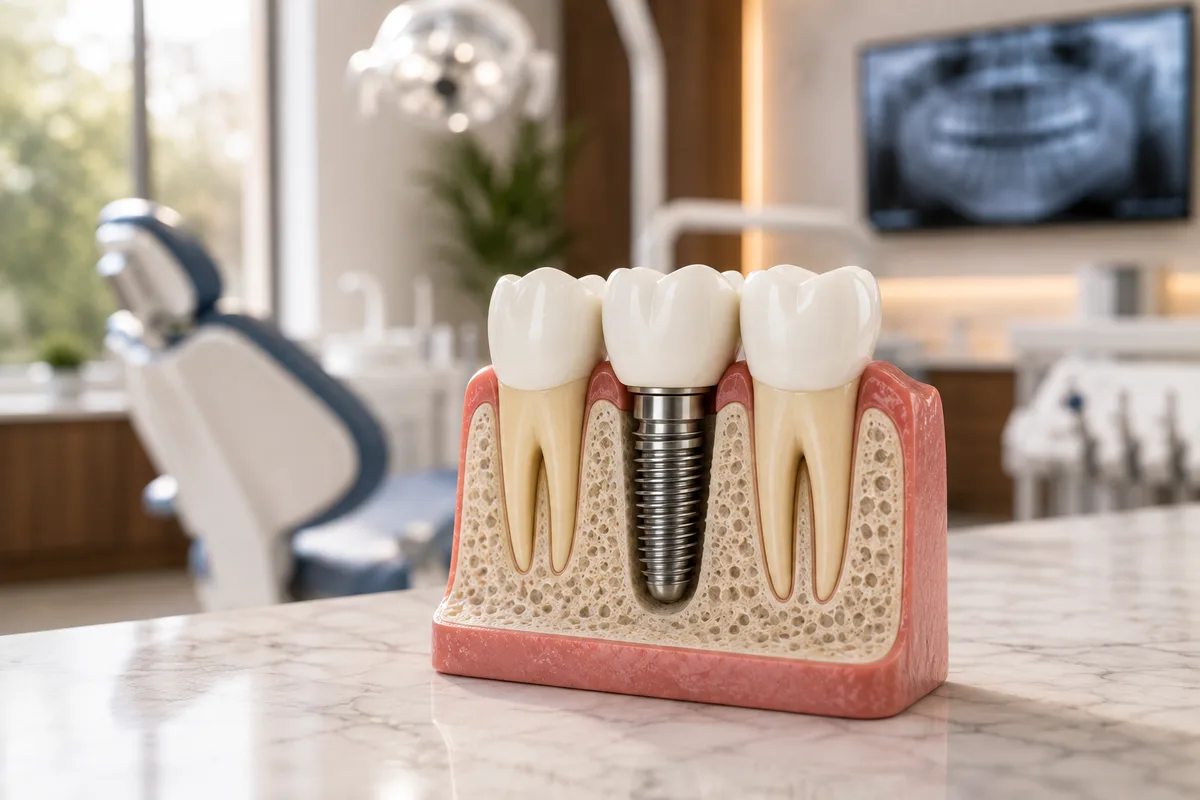
The Treatment
What Is a Dental Implant?
Dental implant surgery replaces failing tooth roots with medical-grade titanium posts, and replaces damaged or missing teeth with artificial teeth that look and work much like real ones. It is the preferred option when dentures or bridgework fit poorly — or when there aren't enough natural roots left to support them.
Because the titanium fuses biologically with your jawbone (a process called osseointegration), implants won't slip, make noise, or cause the bone damage that fixed bridgework or dentures can. And unlike natural teeth, the materials cannot decay.
The major benefit is solid, permanent support for your new teeth — a process that requires the bone to heal tightly around the implant. Because this healing takes time, treatment is staged over several months, most of which is quiet healing between short procedures.
Titanium
Biocompatible post
3–6 mo
Bone integration
Lifetime
Potential lifespan
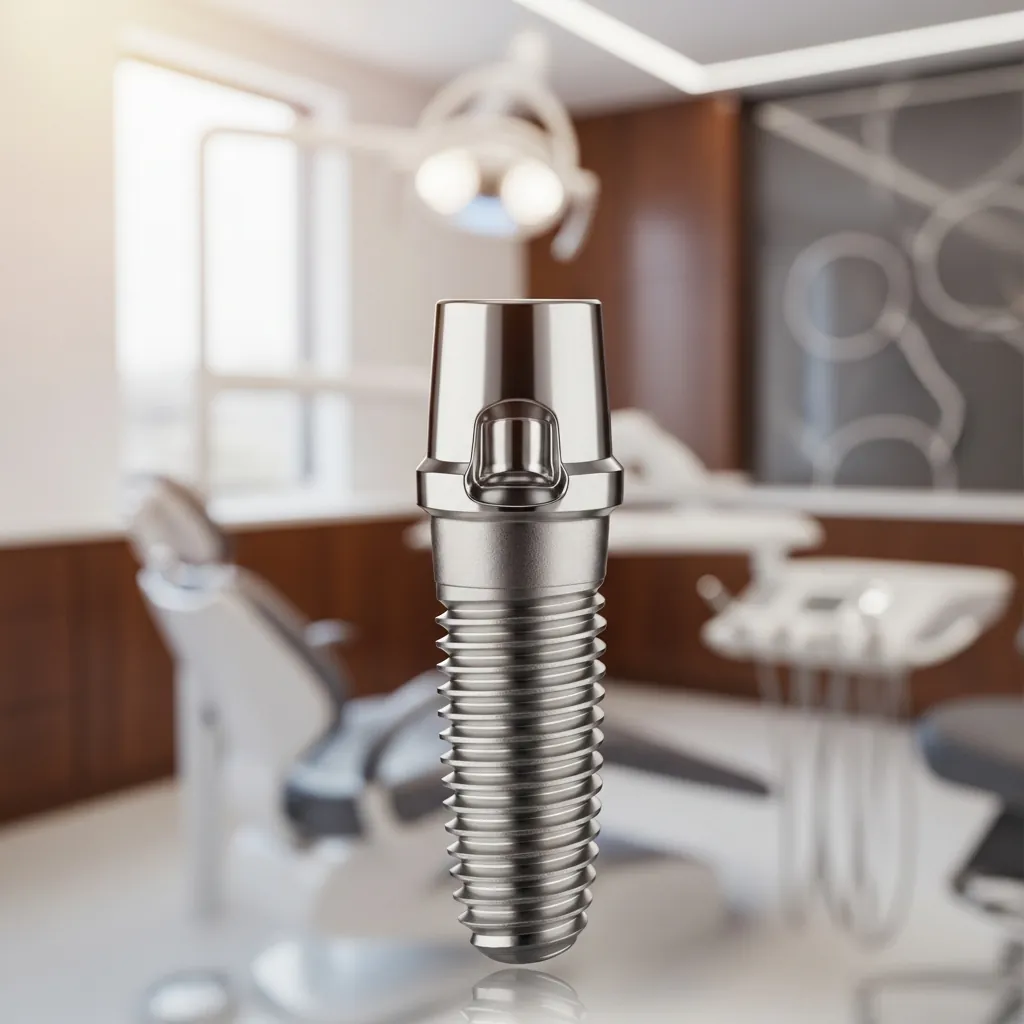
Cross-section model: the titanium post integrates with the jawbone exactly as a natural root would.
Clinical Indications
Is a Dental Implant Right for You?
Implants may be the right choice if the following apply to you. Dr. Abdeen confirms candidacy with a full clinical exam, X-rays, and 3D imaging.
One or More Missing Teeth
Implants replace single teeth, multiple teeth, or support full-arch restorations — without grinding down healthy adjacent teeth the way a bridge requires.
A Fully Developed Jawbone
Implant placement requires a jawbone that has reached full growth, which is why implants are typically reserved for adults.
Adequate Bone Volume — or Graftable Bone
The implant must be anchored in sufficient bone. If bone has resorbed after tooth loss, a bone graft can rebuild a solid foundation first.
Healthy Oral Tissues
Healthy gums free of active periodontal disease are essential for predictable healing and long-term implant stability.
No Conditions That Impair Bone Healing
Uncontrolled diabetes, certain medications, and heavy smoking interfere with osseointegration. Dr. Abdeen reviews your full medical history before treatment.
Poorly Fitting Dentures or Bridgework
Implants are the definitive solution when removable dentures slip, cause sore spots, or when there aren't enough natural roots to support bridgework.
When Bone Grafting Is Needed
Building a Strong Foundation First
The powerful chewing forces of your mouth place enormous pressure on the jawbone. If the bone at the implant site is too thin or too soft to support an implant, the surgery would likely fail — so a bone graft is placed first to create a solid base.
Graft options include natural bone from another site in your body, or synthetic bone-substitute material that scaffolds new bone growth. Dr. Abdeen will recommend the option best suited to your anatomy.
Larger grafts may need several months to mature before implant placement. Minor grafting can often be done at the same time as implant surgery — the condition of your jawbone determines how treatment proceeds.
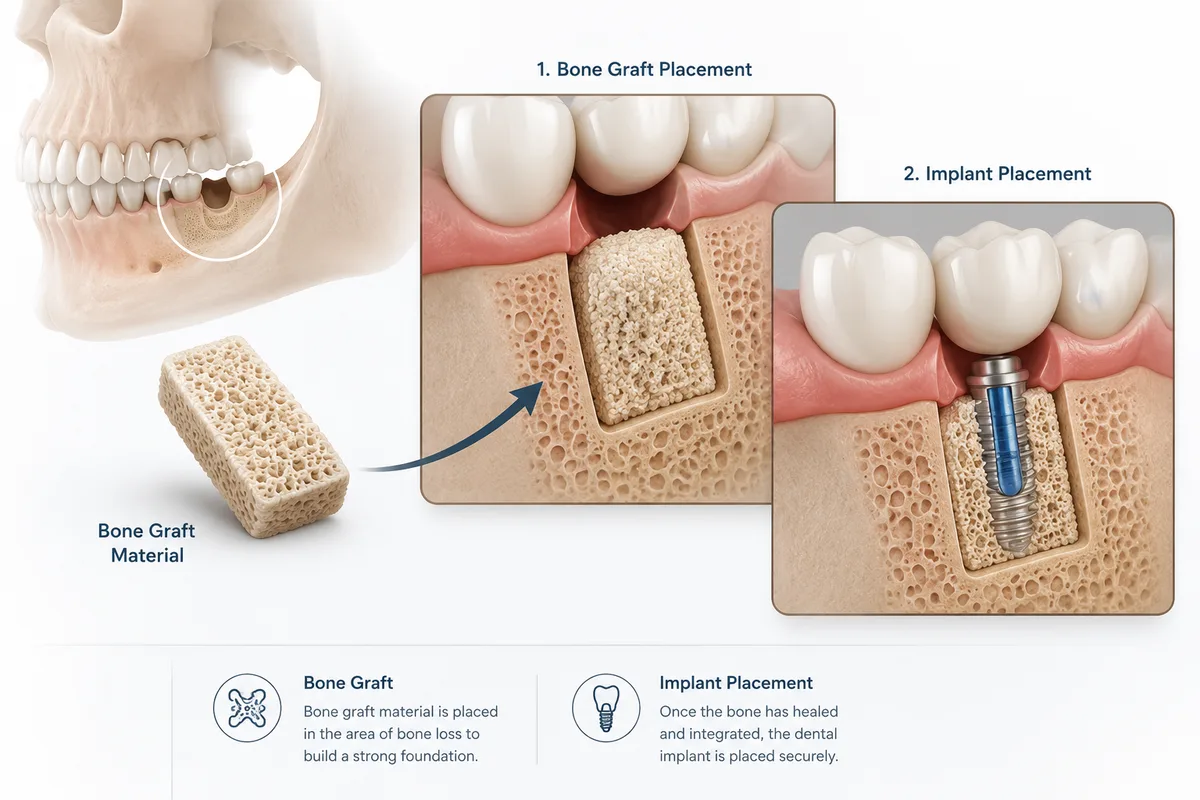
Step 1: graft material rebuilds lost bone. Step 2: once healed, the implant is placed securely.
Educational Video
See How Dental Implants Work
A short clinical overview of how a dental implant replaces a missing tooth from root to crown.
Clinical Workflow
The Dental Implant Process
Implant treatment is staged, with healing time between procedures. Here is every phase explained — most of the timeline is simply your bone quietly doing its work.
Comprehensive Exam, X-Rays & 3D Imaging
Treatment begins with a full dental exam including radiographs and, where indicated, 3D imaging. Models of your teeth and jaw are made, your medical history is reviewed in detail, and a personalized treatment plan is built around how many teeth need replacement and the condition of your jawbone.
Damaged Tooth Removal & Bone Grafting (When Needed)
Any failing tooth is removed. If the jawbone is too thin or too soft to support an implant, bone graft material — natural or synthetic — is placed to rebuild a solid base. Minor grafts can often be done at the same time as implant placement; larger grafts may need several months of healing first.
Implant Placement Surgery
The titanium implant post is placed into the jawbone through a small opening in the gum, where it will serve as the new tooth root. The procedure is done under local anesthesia, with sedation options available. A temporary restoration can be placed for appearance during healing.
Osseointegration — Bone Healing Around the Implant
Over the following months, the jawbone grows into and fuses with the surface of the implant — a process called osseointegration. This biological bond is what gives an implant the same solid, stable support a natural root provides. It cannot be rushed and is the key to long-term success.
Abutment Placement
Once integration is complete, a small connector called an abutment is attached to the implant. This minor procedure is done under local anesthesia, and the gum tissue is shaped around it. In some cases the abutment is placed at the same time as the implant, avoiding a separate step.
Custom Crown — Your New Tooth
After the gums heal, impressions are taken and a custom crown is fabricated to match your natural teeth in shape and shade. The crown is secured to the abutment — fixed permanently or designed to be removable, depending on your treatment plan.
Clinical Comparison
Implants vs. Bridges vs. Dentures
All three replace missing teeth. Only an implant replaces the root — which is what preserves your jawbone over time.
| Factor | Dental Implant | Bridge | Denture |
|---|---|---|---|
| Replaces the root | Yes — titanium post | No | No |
| Preserves jawbone | Yes | No — bone resorbs | No — bone resorbs |
| Affects adjacent teeth | No | Requires grinding neighbors | Clasps stress neighbors |
| Stability | Fixed, like a natural tooth | Fixed | Can slip or shift |
| Can decay | Never | Margins can decay | No, but gums suffer |
| Expected lifespan | Decades to lifetime | 5–15 years | 5–8 years, with relines |
| Daily care | Brush & floss normally | Special floss threaders | Remove & soak nightly |
Note: Bridges and dentures remain appropriate choices in specific clinical situations. Dr. Abdeen will recommend the most suitable restoration after your examination.
After the Procedure
Recovery & Making Your Implant Last
What to Expect While Healing
- Mild swelling of the gums and face, and possible minor bruising, for the first few days.
- Manageable discomfort at the implant site — pain medication is prescribed when needed.
- Soft foods while each surgical site heals; dissolving stitches typically disappear on their own.
- Contact the office promptly if swelling or soreness worsens in the days after surgery.
Protecting Your Investment
- Keep implants, crowns, and gums meticulously clean — interdental brushes reach around posts.
- Maintain regular checkups and professional cleanings so implant health is monitored long-term.
- Avoid chewing ice and hard candy, which can fracture crowns and natural teeth alike.
- Don't smoke — smoking is a leading contributor to implant failure — and treat teeth grinding.
Patient Questions
Frequently Asked Questions
Ready to Replace Your Missing Teeth for Good?
Book a free implant consultation with Dr. Abdeen. We accept most major insurance plans and offer CareCredit financing options.
Have questions?
(703) 671-0626